Aeryon Labs and Aeryon Defense USA
Drone pilot training and certification program for military, law enforcement, public safety, and energy sectors.
Aeryon Labs Inc. is a leading manufacturer of high-performance Unmanned Aircraft Systems (UAS) for military, public safety, and commercial customers and is recognized as one of the 500 fastest growing technology, media, telecommunications, life sciences and energy tech companies in North America.
Aeryon Defense USA is a U.S. defense contractor delivering the next generation of high-performance, small Unmanned Aircraft Systems (sUAS) and software to U.S. military forces and government agencies.
FLIR Systems acquired Aeryon January 2019. FLIR Systems merged with Teledyne to become Teledyne FLIR in 2021.
When Aeryon Labs first engaged with Education Services LLC, all pilot training was delivered face-to-face, through instructor led classroom training followed by live hands-on flight activities in the field. Aeryon hired Education Services to help them modernize the training program, to make effective use of learning science, modern pedagogy, and online technology. Goals included ensuring that all trainees received the same high quality training whether trained by Aeryon instructors, authorized partners, or military trainers, and to reduce the time require for the in-person training while increasing time spent in the field, flying the aircraft under the trainers supervision.
Education Services began by performing instructional design and learning engineering services, defining instructor evaluation rubrics for pilot certification, identifying content appropriate for online independent learning and practice vs. activities that are best facilitated in-person by qualified instructors, and evaluating online technology to enable it all.
Today these training programs have matured through multiple iterations, each more sophisticated than the one before. The program has been well received by customers due to extensive use of multimedia, interactive activities, independent exploration, guided practice ‘pseudo simulators’, and integration of the fully functional mission control software flight simulator.
Trainees can also revisit the online platform at any time to review training materials and practice in the simulators.
Education Services built and supports custom learning platforms used by both divisions. Aeryon is hosted in the AWS public cloud and Aeryon Defense USA is hosted in the secure AWS GovCloud.
Testimonial
Watch this video to hear from Peter Blake, one of Aeryon’s thought-leaders who championed this training effort.
[Narrator] In this customer testimonial video we feature Peter Blake, Director of Training and Support for Aeryon Defense USA, describing how the team at Education Services LLC helped him create a vision for their state-of-the-art training program and then worked with hm to turn that vision into reality.
[Peter] We first came to Education Services looking for a vision for ways that we could take our training and really condense the overall training experience and make it much more valuable and in depth than what you would get when you just sit down on day 1 with an in-person instructor. The modules we have designed for SkyRanger with Ed Services support, really took the vision of making quality, standardized, and repeatable online content that would be the precursor to having students sit down in front of the instructor. For a lot of our customers it was really valuable because it cuts down on the amount of time they need to spend in training. Students can do the online academics before they get to the in-person portion, and on their own pace. We have gotten fantastic feedback from our customers who really see a reduction in the time it takes to train their students. They see a much better product when their students graduate the class when they have had their online content to learn at their own pace. If they have not flown the SkyRanger for a period of time, or if they have annual recertification requirements, they don’t need to fly an instructor in anymore to repeat the content, they can get back online and watch the standardized, repeatable training as a review or annual recertification.
[Narrator] To learn more about this exciting project, visit the Showcase page on www.edsvcs.com.
Training Formats
Online and face-to-face training includes simulations, pseudo-simulations, and formal and informal assessment of skills and knowledge. Online portions are deployed both online and locally on laptops.
Face-to-Face Training
In this format, the full training is delivered by an Aeryon-certified instructor in a face-to-face experience. This is typically used when learners don’t have consistent access to a computer or internet connection prior to their training sessions. Learners are taught the same material and evaluated by the same standards as learners taught in a blended training format.
Blended Training
In this format, students can self-study the first half of the training modules online, and the remaining modules are taught face-to-face by an Aeryon-certified instructor. This approach allocates more in-person training time for advanced topics, practice flights, and passing off certification flights while being evaluated by the instructor.
Online Training
For experienced pilots, online-only training is provided to explain product updates and provide opportunities for practice in the software simulator. This allows these pilots to get up-to-speed quickly, at a time that is most convenient for them, without losing precious flight time for scheduled training sessions.
Methodology
The development methodology for this project was based on the SAM model and Rapid Prototyping. The process has been highly collaborative and iterative, allowing the training to increase in complexity and interactivity as opportunities for growth have been identified and new products have been released.
Watch the video to learn more about how our methodology guided this project.
Aeryon builds high-performance drones for military, public safety, and commercial customers around the world. Training customers to operate the aircraft and to plan and carry out safe and successful flight operations is an important part of their business.
In the past, all training was conducted in-person by Aeryon trainers, with the Pilot Operating Manual serving as the primary reference material.
Education Services was brought in to help re-envision the training experience with special emphasis on the opportunity to make the training more engaging and effective, accessible by more customers at a lower cost, and with greater consistency even when taught by strategic partners or a customer’s own trainers.
The project included overall design of the entire Level 1 pilot training program, creation of standardized evaluation forms for use by trainers during the in-person training sessions, to certify that each participant can properly assemble and disassemble the aircraft, correctly plan and perform a variety of flight operations, and operate in a safe and professional manner.
The first half of the course was re-envisioned as an online experience that students can complete at their own pace. The second half of the course is taught in person by trained Aeryon instructors, including multiple field sessions where each participant has an opportunity to practice flying the actual aircraft while being evaluated by the instructor.
Even though the fully in-person training format is still offered, most customers now elect to use the online “pre-learning” modules followed by a much shorter on-site session. This format saves time and money and results in a better experience and higher customer satisfaction because trainees arrive ready to fly.
For this project, we utilized the Successive Approximation Model, also known as SAM. SAM is a variation of the widely known ADDIE model that uses rapid prototypes and iteration to solidify and deliver the customer’s vision. This model has four phases: preparation, design, development, and rollout.
The preparation phase is used to determine business goals, learning objectives, learner profiles, and other instructional design needs.
The goal of the online training was for pilots to develop as much of the knowledge and skill in advance as possible, so that when participants attend the in-person training they can spend less time in the classroom and more time in the field, flying the aircraft under the trainer’s supervision.
The primary audience for this training is comprised of military, public safety, and commercial operators. They are typically busy men with physically active jobs who are often required by their employers to complete the training.
Based on the goals and learner profiles, it was determined that the online training needed to be concise, gamified, applicable, and interactive to encourage the trainees to complete the lessons prior to their in-person training.
The Design phase was focused on the course structure and content, and selection of an appropriate content authoring tool.
We selected Storyline 360 as the authoring tool because it allows for a high degree of customization, interaction, and media use to meet the training goals. JavaScript and xAPI allowed us to create experiences not possible with the native tools alone, integrate seamlessly with the learning platform, personalize the training portal for each participant, and enables instructor tools like reports that show when each student starts, progresses, and finishes each training module and allowing instructors to award Certificates of Completion to participants who pass all the required online activities and in-person flight evaluations.
For this project, the Development phase was used to build the training and continuously improve it with each release, typically corresponding with new versions of the Aeryon products and based on stakeholder and user feedback.
Considering their customer profile, we focused on making the training engaging and interesting with lots of media, interaction, and other active learning techniques. For example, every module begins with a short video that shows and explains what this module is about and why it’s important to learn. Even simple things like learning the names and purpose of each control icon in the flight control software has been transformed. Students no longer read pages of text descriptions. Now they engage an interactive gamified activity where students learn by exploring and marking off each item as they learn it.
We also pushed the boundaries of what skills can be learned online by building guided-practice pseudo-simulations that first demonstrate and explain how to perform a flight activity then lead the student through the same activity with audible and on-screen prompts, much like how the instructor would do if they were sitting together in person. After practicing in the pseudo-simulators, trainees can practice using the actual flight control software that has been seamlessly integrated with the online course.
This training has gone through several iterations based on collaboration with Aeryon leadership, trainers, and customers, and is a great example of the impact that well-designed online learning can have.
The Rollout phase was focused on implementing the training on two different learning platforms.
Aeryon Labs serves their global customers through a commercial platform running in the public cloud. Education Services was engaged to lead the platform evaluation and selection process, ensuring the system could meet current and future needs and can be managed in-house by existing staff.
Aeryon Defense USA serves their customers through a custom training platform built by Education Services that runs in a private cloud. This system was designed to meet special requirements for their US military customers. The platform utilizes xAPI to track all learner activity, and it allows learners to navigate easily between modules, see their progress, and pick up right where they left off last time. It also allows their trainers and other group leaders to maintain their own course rosters and award Certificates of Completion to participants who pass all the necessary requirements and flight evaluations.
Examples From The Training
Several examples from the actual training course are included below.
Contact us for a guided demonstration.
Mission Control Station
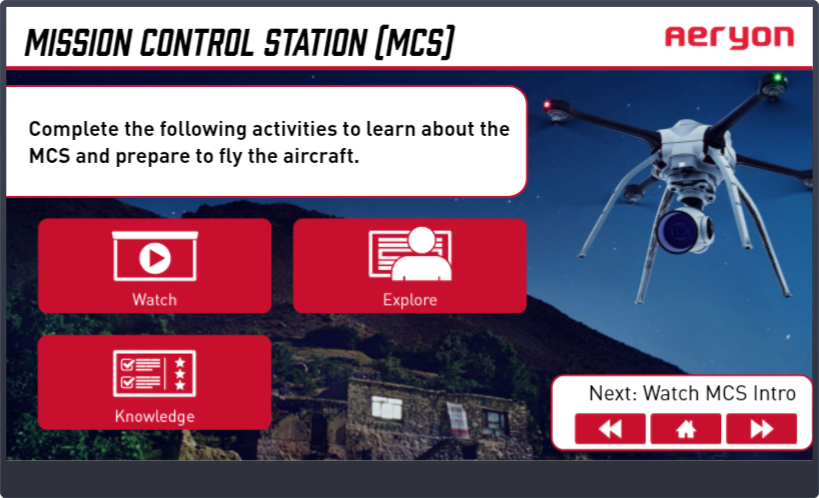
This module introduces the Aeryon Mission Control Station (MCS) software. The module consists of 3 interactive activities:
Watch – A video style multi-media presentation that introduces the MCS and prepares the student for the next activity.
Explore – An interactive exercise where the student learns the name and purpose of each control in the MCS user interface.
Knowledge Check – An end of module quiz to confirm and validate learning.
Basic Flight Controls
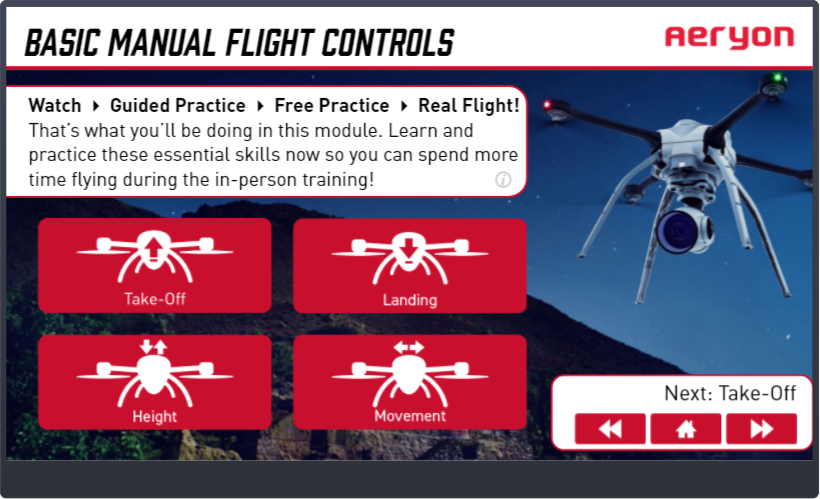
This module teaches the basic flight controls using a “see one, do one” approach. Using this approach, the student first watches the operation as it is explained and performed correctly, then they perform the same operation in a guided practice activity in preparation for free-flight practice using the fully functional Aeryon MCS Simulator. This allows the student to get comfortable using the flight software prior to the in-person field activity where they will fly the actual aircraft while being evaluated by an Aeryon-trained instructor.
Mission Planning
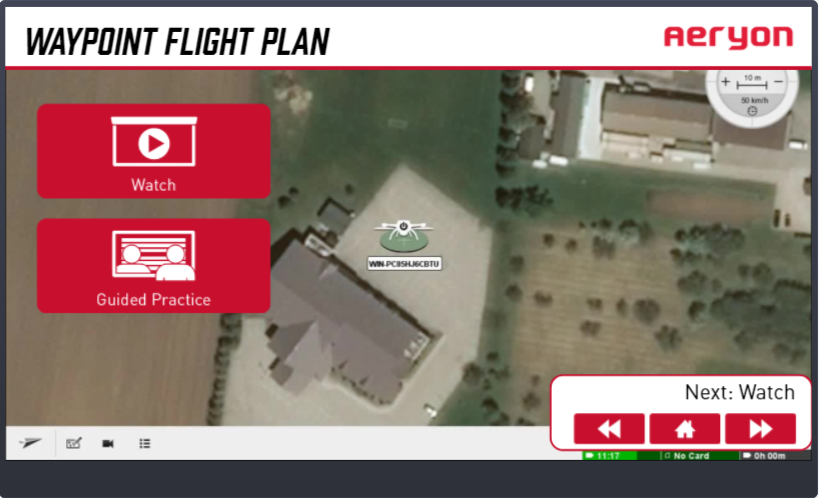
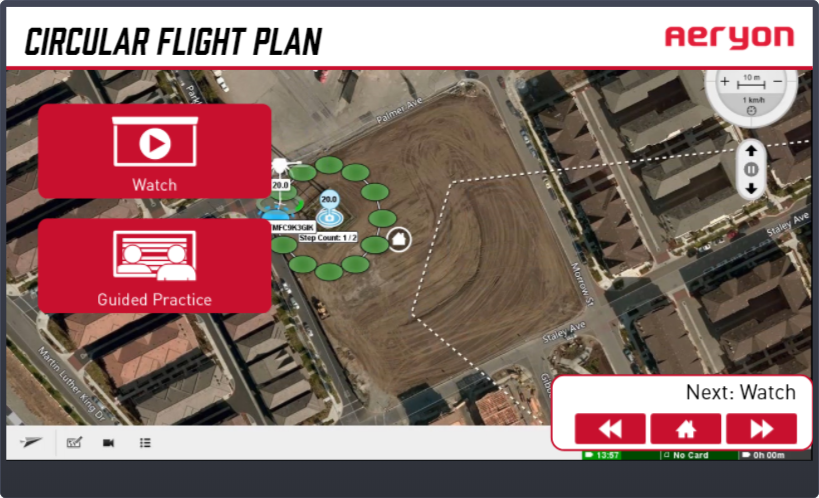
The Level 1 course includes training on how to plan and execute all three types of semi-autonomous flight plans using the same “see one, do one” approach that students became familiar with while learning and practicing Basic Flight Controls.